
Side Hustles, Online Selling and the £1,000 Trading Allowance
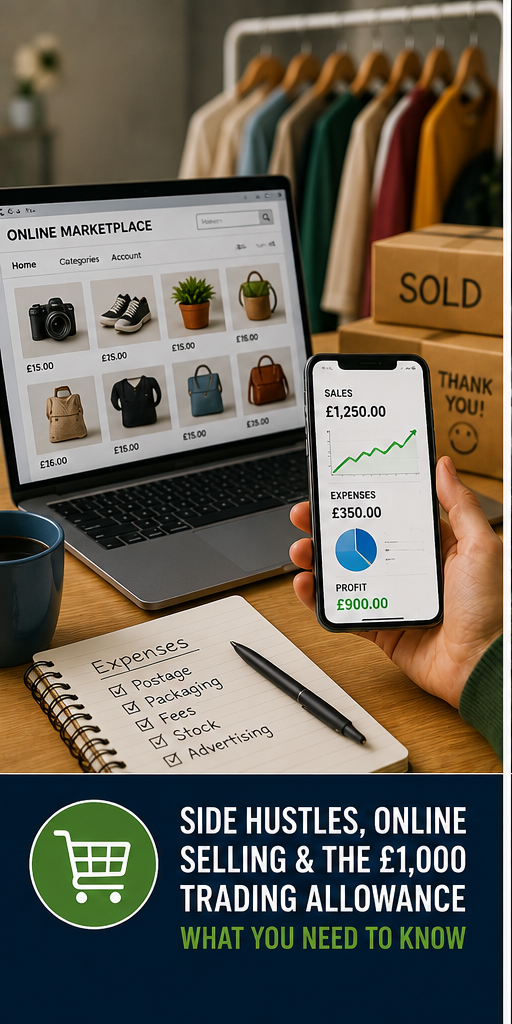
Selling a few unwanted items online is one thing. Regularly buying products to resell, freelancing through an app or earning money from content creation is something very different.
The growth of platforms such as eBay, Vinted, Etsy, Airbnb and various freelance and delivery apps has made it easier than ever to earn additional income.
It has also created a great deal of confusion about when that income becomes taxable and when it needs to be reported to HMRC.
A common misconception is that income earned through a “side hustle” is automatically tax-free. Another is that HMRC will not know about it unless you complete a tax return.
Neither assumption is necessarily correct.
What counts as a side hustle?
A side hustle can cover almost any activity carried out to generate additional income, including:
- selling products online;
- providing freelance services;
- making and selling crafts;
- earning advertising or sponsorship income;
- delivering food or parcels;
- gardening or cleaning;
- babysitting or tutoring;
- renting out equipment;
- creating paid online content; and
- providing accommodation through an online platform.
However, not every payment you receive means that you are trading.
Someone selling their old clothes or clearing unwanted belongings from their home is not necessarily carrying on a business. By contrast, someone regularly buying products with the intention of selling them at a profit is much more likely to be trading.
HMRC will look at the nature, frequency and commercial purpose of the activity—not simply which website or app was used.
What is the trading allowance?
The trading allowance allows an individual to receive up to £1,000 of gross trading income in a tax year without normally having to pay tax on that income or report it to HMRC, provided no other reporting requirement applies.
The important word is income.
The £1,000 threshold is not based on profit after deducting expenses. It refers to the total amount received before costs are taken off.
For example, suppose you receive £1,200 from online sales but spend £800 buying the products, paying platform fees and covering postage.
Your accounting profit may only be £400, but your gross trading income is still £1,200. You have exceeded the £1,000 trading allowance threshold and may need to report the activity.
Two ways of calculating your taxable profit
Where your trading income exceeds £1,000, you can normally calculate your taxable profit in one of two ways.
The normal expenses method
Under this method, you deduct allowable business expenses from your trading income.
These expenses might include:
- stock and materials;
- platform fees;
- postage and packaging;
- advertising;
- business software;
- certain travel costs;
- professional fees; and
- an appropriate proportion of other genuine business expenses.
The remaining profit is potentially subject to income tax and National Insurance, depending on your circumstances.
Claiming the £1,000 allowance
Alternatively, you may be able to deduct the £1,000 trading allowance instead of claiming your actual expenses.
For example, if your income is £3,000 and your actual expenses are only £400, claiming the £1,000 allowance would produce a taxable profit of £2,000.
Claiming actual expenses would produce a taxable profit of £2,600.
In that situation, the allowance would give the better result.
However, if your genuine allowable expenses exceed £1,000, claiming the actual costs will normally be more beneficial.
You cannot claim both the trading allowance and your actual expenses against the same income.
The allowance applies across all your trading income
The £1,000 allowance does not apply separately to every side hustle.
Suppose you receive:
- £600 from gardening;
- £450 from online selling; and
- £300 from freelance work.
Your combined gross trading income is £1,350. You cannot claim a separate £1,000 allowance for each activity.
The limit applies to your combined trading income for the tax year.
It may therefore be necessary to consider all your self-employed and side-business activities together.
The allowance cannot create a loss
The trading allowance can reduce taxable trading income to nil, but it cannot create a tax loss.
This can matter during the early stages of a business.
Suppose your income is £800 and your genuine allowable expenses are £2,000. Using the trading allowance would simply reduce your taxable income to nil.
By calculating the result under normal accounting rules, you may instead generate a £1,200 trading loss. Depending on your circumstances, that loss might be carried forward or relieved in another permitted way.
Registering and reporting the activity may therefore be worthwhile even where your income is below £1,000.
When is the allowance unavailable?
The trading allowance is subject to restrictions.
According to the supplied material, it cannot normally be claimed against trading income received from:
- a company controlled by you or someone connected with you;
- a partnership in which you or a connected person has an interest;
- your employer; or
- your spouse’s or civil partner’s employer.
These restrictions are intended to prevent normal employment or connected-business income from being redirected and sheltered by the allowance.
Online platforms report information to HMRC
There has been a great deal of alarm about online marketplaces reporting sellers to HMRC.
The key point is that a platform reporting your information does not automatically mean you owe tax.
Similarly, falling below a platform’s reporting threshold does not automatically mean your income is tax-free.
The reporting rules and the tax rules serve different purposes.
Online platforms may collect and provide information about certain sellers, landlords, drivers, freelancers and content creators to HMRC.
HMRC can then compare that information with tax returns and other records.
This makes it increasingly risky to assume that online income will remain invisible.
Selling possessions is not automatically taxable
Selling your own unwanted belongings will not usually amount to trading.
For example, selling clothes that no longer fit or furniture you no longer need will generally be different from deliberately buying items to resell at a profit.
The distinction can become less clear where someone:
- sells frequently;
- buys stock specifically for resale;
- improves or modifies items before selling;
- operates in a commercially organised way; or
- consistently seeks to make a profit.
Good records will help demonstrate what was sold, why it was originally purchased and whether a genuine trading activity exists.
A higher reporting threshold has been proposed
The source material refers to government plans to increase the self-assessment reporting threshold for trading income from £1,000 to £3,000 within the current Parliament and by 2029.
Importantly, this is described as a reporting change rather than an increase in the trading allowance itself.
Under the proposal, some individuals could have tax to pay despite no longer needing to complete a full self-assessment tax return. A simplified reporting service is intended for those cases.
Until any change takes effect, individuals should continue to follow the current rules rather than assuming the £3,000 threshold already applies.
Keep proper records from the beginning
Even a relatively small side business should keep records of:
- income received;
- platform statements;
- fees and commissions;
- refunds and cancellations;
- stock purchases;
- postage;
- business mileage;
- equipment costs; and
- other relevant expenditure.
Waiting until the end of the tax year and trying to reconstruct everything from bank statements is rarely the best approach.
Better records help establish whether tax is due and ensure that every legitimate expense and relief is considered.
Unsure whether your side income needs reporting?
A side hustle can grow into a meaningful business surprisingly quickly.
At williams lester accountants, we can help you determine whether your activity amounts to trading, whether registration is required and which method of calculating your taxable profit gives the best result.
Getting advice early is far easier than explaining undeclared income after HMRC has received information directly from an online platform.