
Should Your Limited Company Buy Your Bicycle?
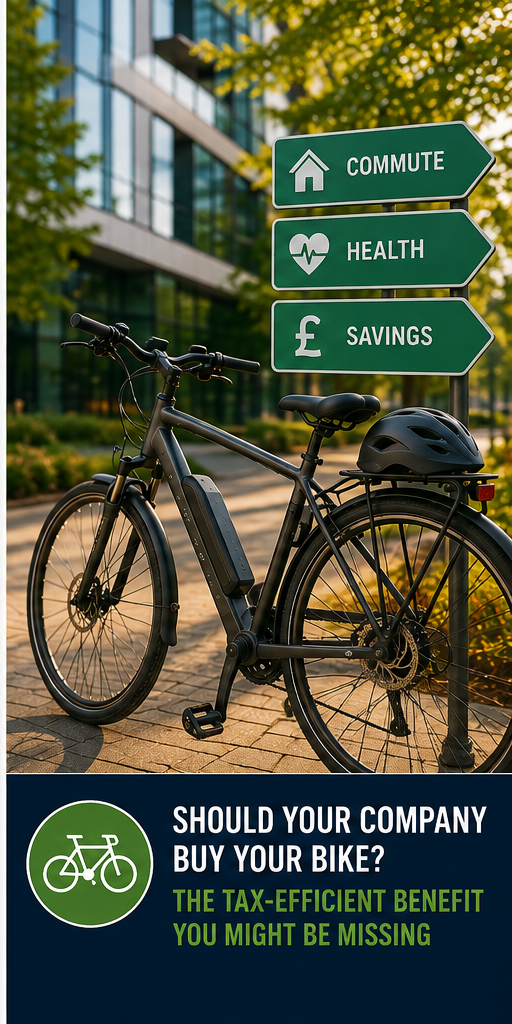
A company car is one of the best-known benefits a business can provide.
Unfortunately, it can also come with a substantial benefit-in-kind tax charge—particularly where the vehicle is not fully electric.
A company bicycle can be very different.
Where the conditions are met, a limited company may be able to buy a bicycle or electric bike, obtain corporation tax relief and allow a director or employee to use it for commuting without creating a taxable benefit.
For many owner-managed companies, this can be a relatively simple and tax-efficient arrangement.
Option one: the company buys and owns the bicycle
The most straightforward approach is for the limited company to purchase the bicycle and retain ownership.
The company then makes it available to a director or employee.
The company may be able to claim capital allowances on the cost of the bicycle. Depending on the circumstances, this could provide full tax relief through the annual investment allowance.
Where the company is VAT-registered and the relevant conditions are satisfied, it may also be possible to recover VAT relating to the bicycle and qualifying accessories.
Potential accessories could include items such as:
- lights;
- locks;
- bells;
- certain safety equipment; and
- other items supplied as part of the bicycle arrangement.
The VAT position will depend on the use of the bike and the normal VAT rules.
Can a director use the bike personally?
Some private use is permitted.
For the employee or director to avoid a taxable benefit-in-kind charge, the arrangement needs to meet the relevant exemption conditions.
The supplied material identifies three key requirements:
- Ownership of the bicycle must not be transferred to the employee.
- The bicycle must be used mainly for qualifying journeys.
- Bicycles must be made available generally to employees.
Qualifying journeys include commuting between home and the normal workplace, together with business travel between workplaces.
The exemption can also apply to qualifying electrically assisted pedal cycles.
What does “mainly” used for qualifying journeys mean?
More than 50% of the bicycle’s use should relate to qualifying journeys.
That does not mean the director or employee is forbidden from taking the bike for a weekend ride.
Leisure use is permitted, provided commuting and other qualifying business journeys remain the main use.
The source material notes that HMRC does not normally expect detailed mileage records where there is no clear evidence that qualifying journeys represent less than half of the bike’s use.
Nevertheless, retaining some evidence of regular commuting or business use would be sensible.
Does the company need a formal cycle scheme?
Not necessarily.
A limited company can purchase a bicycle and make it available to an employee or director without obtaining advance approval from HMRC or operating a formal salary sacrifice scheme.
For many small owner-managed businesses, this direct company-purchase route can be considerably simpler.
The company should still document:
- the purchase;
- company ownership;
- who the bike has been provided to;
- the expected qualifying use; and
- the terms on which it is available.
The bicycle should also be recorded as a company asset.
What does “available generally to employees” mean?
The exemption requires the opportunity to be available generally to employees.
This does not necessarily mean that the company must buy a bicycle for every employee immediately.
It means the arrangement should not be structured as an exclusive benefit that other eligible employees are prevented from accessing.
For a company with one director and no other staff, the condition is normally simpler to address.
Where there are several employees, the company should have a genuine and consistently applied policy.
What about the Cycle to Work scheme?
The better-known Cycle to Work arrangement usually involves salary sacrifice.
Under that approach, an employee gives up part of their gross salary in exchange for the use of a bicycle supplied by their employer.
The employee may save income tax and National Insurance because the salary reduction is made before those liabilities are calculated.
The employer may also save employer’s National Insurance.
This can be attractive for businesses with employees receiving ordinary PAYE salaries.
Salary sacrifice may not help a low-salary director
Many owner-managed company directors take a relatively modest salary and receive further income through dividends.
Where the director’s salary already produces little or no employee income tax or National Insurance, sacrificing part of that salary may create limited additional savings.
The arrangement can also create more administration, including:
- a formal salary sacrifice agreement;
- changes to the employment contract;
- correct treatment through payroll;
- a bicycle hire agreement; and
- consideration of National Minimum Wage restrictions for employees.
For that reason, having the company buy and retain the bicycle directly may be simpler for a small owner-managed company.
What happens when the employee wants to own the bike?
The tax exemption applies while ownership remains with the company.
The employee does not automatically become the owner at the end of a particular period.
Where the company later transfers the bicycle to the employee for nothing or for less than its market value, a taxable benefit may arise.
To avoid this, the employee would generally need to pay an appropriate market value.
HMRC provides guidance and simplified valuation percentages that may be used to estimate the value of a bicycle according to its age and original cost.
Alternatively, the company can continue to own the bicycle and allow the employee to continue using it.
Electric bikes can qualify
The exemption is not restricted to traditional pedal bicycles.
Qualifying electrically assisted pedal cycles can also be included.
Given the cost of some electric bikes, company purchase can be particularly attractive where the bike will genuinely be used mainly for commuting or business journeys.
However, care is needed to ensure that the vehicle falls within the relevant definition of an electrically assisted pedal cycle rather than being treated as a motor vehicle.
What records should the company keep?
The company should retain:
- the purchase invoice;
- evidence of payment by the company;
- details of VAT claimed;
- the capital allowance treatment;
- an asset register entry;
- confirmation that the company retains ownership;
- details of the employee or director using the bike;
- a written policy or agreement; and
- reasonable evidence that it is mainly used for qualifying journeys.
Good documentation helps demonstrate that the arrangement was established correctly rather than being a personal purchase put through the company after the event.
Is a company bicycle right for you?
The tax treatment can be attractive, but it must reflect a genuine company-provided asset used mainly for commuting or business travel.
At williams lester accountants, we can help you compare direct company ownership with a Cycle to Work salary sacrifice arrangement and ensure the purchase is treated correctly for corporation tax, VAT, payroll and benefit-in-kind purposes.
A bike may not replace every business journey—but it could be one of the simpler tax-efficient benefits your company provides.