
Can Landlords Use Incorporation Relief When Moving Property Into a Company?
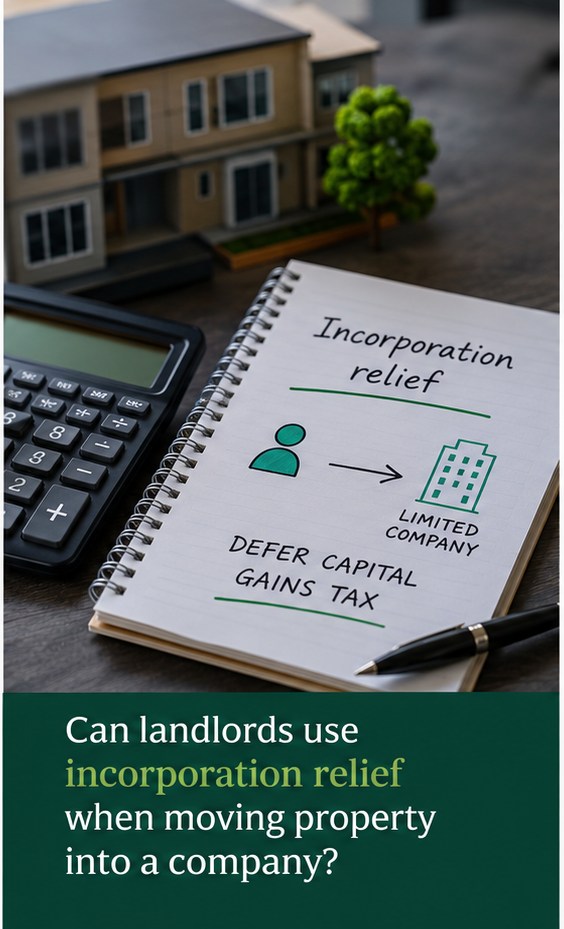
Many landlords are considering whether they should hold their rental properties through a limited company.
The potential reasons include succession planning, bringing family members into the business, retaining profits for future investment and changing the way future income is taxed.
However, transferring an existing property portfolio to a company is not simply an administrative change.
For tax purposes, the properties are generally treated as being transferred from the landlord to a separate legal person: the limited company. This can create a capital gains tax charge based on the properties’ market values, even where the landlord owns the company.
Incorporation relief may allow the capital gain to be deferred—but only where the relevant conditions are met.
What does incorporation relief do?
Incorporation relief can apply when an individual transfers a business to a company as a going concern in exchange wholly or partly for shares.
Rather than paying all the capital gains tax immediately, the qualifying gain is effectively rolled into the shares received from the company.
The base cost of those shares is reduced by the deferred gain. The gain may therefore become taxable later when the shares are eventually sold.
The relief delays the tax charge. It does not necessarily remove it permanently.
It is also important to recognise that incorporation relief must be claimed. Landlords should not assume that it will be given automatically.
Is being a landlord enough?
The central difficulty is that the relief applies to the transfer of a business, rather than the passive ownership of investments.
A landlord may own several properties and receive substantial rental income, but that does not automatically establish that they are carrying on a business for incorporation relief purposes.
The question is broader than the number of properties owned.
Relevant factors can include:
- the time spent managing the portfolio;
- the regularity and continuity of the activities;
- the range of work undertaken personally;
- the scale and substance of the operation;
- whether the activities are organised on recognised business principles; and
- whether the operation is actively pursued with a view to profit.
Activities might include dealing with tenants, arranging repairs, managing contractors, collecting rent, maintaining records, inspecting properties, handling compliance matters and managing new lettings.
Simply receiving rent and occasionally approving repairs may be less persuasive than actively operating and managing a substantial portfolio.
The significance of the Ramsay case
The meaning of a property business was examined in the case of Ramsay v HMRC.
Mrs Ramsay was personally involved in managing her property for approximately 20 hours each week. The Upper Tribunal concluded that the degree of activity was sufficient to amount to carrying on a business.
The important point was not merely the number of properties involved. It was the nature and extent of the activities taken as a whole.
Following the case, spending around 20 hours per week on business-like property activities has often been treated as a useful indicator that incorporation relief may be available.
However, it should not be regarded as an automatic pass.
Is there really a 20-hour rule?
There is no simple statutory rule stating that every landlord who works 20 hours each week qualifies.
More recent tribunal decisions considering the meaning of a business in other statutory contexts have reinforced the need to consider the complete picture rather than relying on a single numerical test.
A landlord who records 20 hours of activity may still need to demonstrate that:
- the activities are genuine and commercially meaningful;
- the operation has sufficient substance;
- the portfolio is actively managed;
- the work is undertaken personally by the landlord; and
- an identifiable business is being transferred as a going concern.
Conversely, failing to reach exactly 20 hours does not necessarily prove that no business exists. Each case depends on its facts and the particular legislation involved.
The whole business must generally be transferred
Incorporation relief usually requires the business to be transferred as a going concern, together with all its assets other than cash.
Problems can arise where a landlord wishes to:
- retain one or more properties personally;
- transfer only selected properties;
- leave certain liabilities outside the company;
- transfer the properties without transferring the wider operation; or
- receive most of the consideration as cash or a director’s loan rather than shares.
The structure of the transaction can materially affect how much of the gain qualifies for relief.
Incorporation relief is only one part of the decision
Even where capital gains tax can be deferred, transferring property into a company can create other tax and commercial costs.
These may include:
- SDLT on the company’s acquisition;
- refinancing costs and early repayment charges;
- increased mortgage rates;
- legal and valuation fees;
- restrictions imposed by lenders;
- tax on extracting money from the company;
- annual company administration; and
- future tax when the properties or company shares are sold.
Partnership arrangements may introduce further considerations. Care is needed because describing a jointly owned portfolio as a partnership does not necessarily make it one for tax purposes.
Evidence matters
Landlords who may rely on incorporation relief should keep contemporaneous evidence showing how the portfolio operates.
Useful records can include:
- time logs;
- correspondence with tenants and contractors;
- maintenance records;
- property inspection notes;
- bookkeeping and management records;
- documented procedures;
- evidence of marketing and tenant selection;
- details of rent collection and arrears management; and
- records showing who performs each activity.
Trying to reconstruct this evidence after HMRC opens an enquiry is far more difficult than keeping it as the business develops.
Do the calculations before incorporating
Moving property into a company should not be driven by a general belief that companies pay less tax.
The immediate transfer taxes, ongoing tax position, financing costs and long-term exit strategy all need to be modelled.
At williams lester accountants, we can help you assess whether your activities are likely to constitute a business, calculate the possible tax charges and compare incorporation with keeping the properties personally.