Phoenix Companies: When Starting Again Could Put Directors at Risk
A limited company can fail for entirely genuine reasons.
Customers may collapse, costs may rise unexpectedly, a key contract may be lost or an otherwise viable business may simply run out of cash.
Closing one company and later starting another is not automatically illegal.
However, directors who repeatedly leave unpaid tax and other creditors behind before continuing substantially the same business through a new company are attracting increasing attention from HMRC, Companies House and the Insolvency Service.
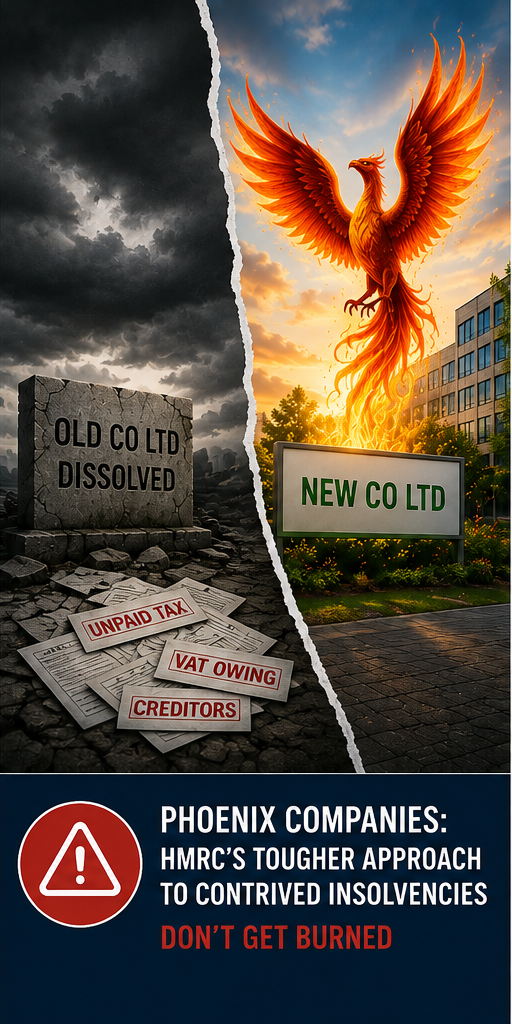
This practice is often described as phoenixing.
What is a phoenix company?
Phoenixing occurs where an existing company stops trading or enters insolvency and a new company then carries on substantially the same business.
The new operation may have:
- the same directors;
- the same customers;
- the same employees;
- the same trading premises;
- the same assets;
- a similar company name; and
- essentially the same commercial activity.
The new company rises from the remains of the old one—hence the reference to the mythical phoenix.
There may be legitimate circumstances in which a viable part of an insolvent business is rescued and continued.
The concern arises where insolvency is deliberately or repeatedly used to avoid paying creditors, particularly HMRC.
Why HMRC is taking a tougher approach
The source material refers to a joint strategy announced in November 2025 involving HMRC, the Insolvency Service and Companies House.
The aim is to target what the government describes as contrived insolvencies.
These are company failures that may have been engineered or exploited to avoid tax while allowing the same underlying business to continue.
Greater information sharing between the three bodies should make it easier to identify patterns such as:
- repeated company failures involving the same directors;
- substantial unpaid VAT, PAYE or corporation tax;
- assets moving between connected companies;
- a new company taking over the old company’s trade;
- repeated applications to strike off companies with unpaid liabilities; and
- directors who continue operating as though little has changed.
Directors should not assume that each limited company will be viewed entirely in isolation.
When closing a solvent company can reduce tax
There is a separate tax issue where a solvent company is formally wound up and its retained funds are distributed to its shareholders.
Ordinary dividends are taxed as income at the shareholder’s applicable dividend tax rate.
By contrast, distributions made during a formal winding up may normally be treated as capital proceeds arising from the disposal of the shareholder’s shares.
Capital gains tax rates can be lower than dividend tax rates. Where the conditions are satisfied, Business Asset Disposal Relief may reduce the capital gains tax rate further.
This can make formal liquidation attractive where a business has genuinely ceased and the shareholders wish to extract the remaining funds.
However, problems arise where an owner closes one company, receives the funds under the capital gains tax rules and then resumes the same or a similar trade through another business.
HMRC may argue that the liquidation was primarily undertaken to convert what would otherwise have been dividend income into a capital gain.
The targeted anti-avoidance rule
A specific targeted anti-avoidance rule, often shortened to TAAR, can treat liquidation proceeds as income rather than capital.
Based on the supplied material, the rule can apply where the following conditions are met:
- The person receiving the distribution held at least a 5% interest in the company immediately before it was wound up.
- The company was a close company during the relevant two-year period.
- The individual continues to carry on, or be involved with, the same or a similar trade within two years of receiving the distribution.
- It is reasonable to assume that a main purpose of the winding up was to avoid or reduce income tax.
Where the rule applies, the expected capital gains tax treatment may be replaced by income tax treatment.
That could substantially increase the tax bill.
The two-year period is important
Business owners sometimes assume that they are safe if the new business is not operated through another limited company.
However, the anti-avoidance rules are concerned with the individual continuing or becoming involved in the same or a similar activity.
Depending on the circumstances, this could include involvement through:
- a new company;
- a partnership;
- a sole trade;
- a connected business; or
- another structure through which substantially the same trade continues.
HMRC can consider events both at the time of the liquidation and afterwards.
A decision made several months after the company closes could therefore affect the tax treatment of an earlier distribution.
Not every restart is abusive
A failed business does not prevent a director from ever operating in the same industry again.
There may be sound commercial reasons for a fresh start.
The key questions are likely to include:
- Why did the original company fail?
- Were the tax debts unavoidable or deliberately accumulated?
- Were creditors treated properly?
- Were company assets transferred at a fair value?
- Was the insolvency process conducted correctly?
- Was the company wound up primarily to secure a tax advantage?
- How similar is the new business?
- How quickly did trading restart?
- Does the director have a history of repeated company failures?
The evidence and commercial rationale matter.
Directors can become personally liable
A limited company is normally responsible for its own tax debts.
One of the main purposes of incorporating a business is to create a separate legal entity with limited liability.
However, limited liability is not absolute.
The source material notes that HMRC can, in certain circumstances, issue a Joint and Several Liability Notice where it believes there has been:
- repeated tax avoidance;
- deliberate tax evasion; or
- a pattern of phoenixing.
Where such a notice is issued, directors or other connected individuals may become personally responsible for relevant company tax debts.
This can expose personal savings and assets to recovery action.
HMRC may demand a security deposit
HMRC can also require businesses considered high-risk to provide security against future tax liabilities.
A security deposit may relate to liabilities such as:
- VAT;
- PAYE;
- National Insurance; and
- other amounts due to HMRC.
This can create a serious cash-flow problem for a newly formed business.
Continuing to trade without providing security after HMRC has formally required it may also amount to a criminal offence.
The importance of taking early advice
Directors often leave professional advice until the company is already under severe financial pressure.
By that stage:
- tax liabilities may be overdue;
- creditors may be threatening legal action;
- the company may be unable to pay wages;
- directors may have continued trading without a viable recovery plan; and
- the available options may have narrowed considerably.
Early intervention can help directors understand whether the business can be rescued, refinanced, sold or closed in an orderly way.
It also creates a better opportunity to document the commercial reasons for any restructuring.
Thinking of closing one company and starting another?
Do not assume that forming a new company automatically leaves the old company’s problems behind.
At williams lester accountants, we can work with you and an appropriately qualified insolvency practitioner to review the company’s position, the tax consequences of closure and the risks of continuing a similar business.
The earlier you seek advice, the greater the chance of protecting both the business and your personal position.