Too Good to Be True? How to Spot Bad Tax Advice Before It Costs You Thousands
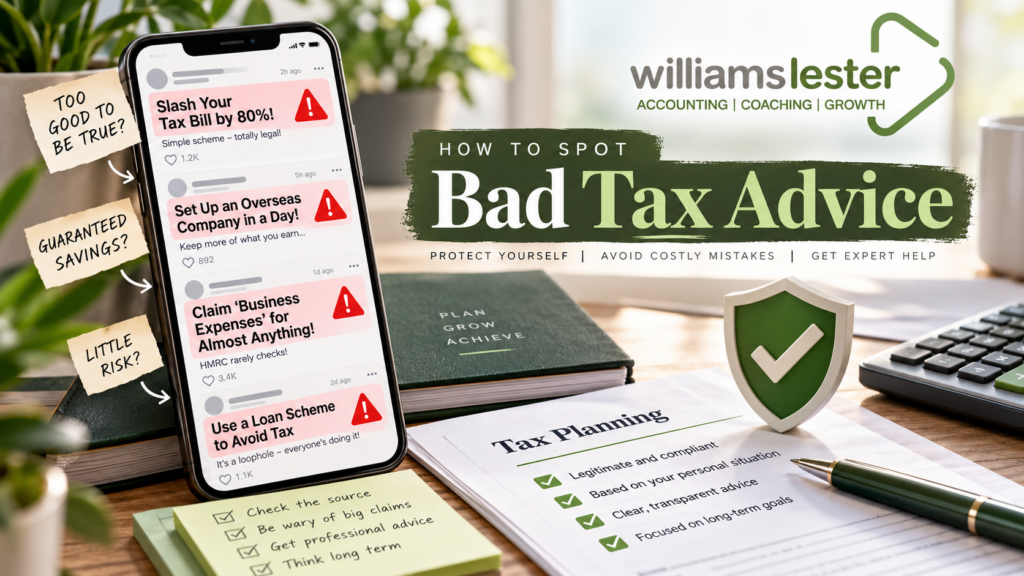
Social media is full of people promising clever ways to reduce your tax bill. But following the wrong advice could leave you facing an HMRC investigation, unexpected tax liabilities and substantial penalties.
Whether you’re running a business, working as a contractor or simply trying to make your money go further, finding legitimate ways to reduce your tax bill makes perfect sense.
Unfortunately, not all tax advice is created equal.
HMRC has issued warnings about misleading tax advice circulating online, particularly from so-called finfluencers — financial influencers who promote seemingly attractive tax-saving arrangements through social media, videos and online advertising.
Some of this advice is simply incorrect. Other arrangements may involve aggressive tax avoidance schemes that could leave taxpayers facing serious financial consequences.
The problem is that an arrangement can sound entirely convincing until HMRC starts asking questions.
Tax planning, tax avoidance and tax evasion: What’s the difference?
Understanding these three terms is important.
Legitimate tax planning involves using the reliefs, allowances and exemptions Parliament intended taxpayers to use.
Examples include making qualifying pension contributions, claiming legitimate business expenses, using available capital allowances or structuring company remuneration appropriately.
Tax avoidance generally involves arrangements designed to obtain a tax advantage in a way that conflicts with the purpose of the legislation.
Some arrangements rely on artificial transactions, complicated contractual structures or payments that disguise their true nature.
Tax evasion involves deliberately breaking the law, such as concealing income or knowingly submitting false information to HMRC.
Good tax planning can reduce your liabilities legally and sustainably. Tax avoidance schemes can create significant risks, even where promoters claim their arrangements are legitimate.
Seven warning signs of questionable tax advice
1. Someone promises you can pay almost no tax
Be suspicious of schemes promising unusually high take-home pay or dramatic tax reductions without a clear commercial explanation.
There is no universal arrangement that allows everyone to escape Income Tax or National Insurance.
2. Payments are described as loans, gifts or rewards
Certain arrangements claim that money received by an employee or director is not taxable because it is structured as a loan, capital payment, reward or another form of benefit.
However, calling a payment something different does not necessarily change its tax treatment.
HMRC considers the underlying substance of the arrangement, not simply the terminology used.
3. The promoter claims the scheme is HMRC-approved
HMRC does not generally approve commercial tax avoidance schemes.
The existence of a disclosure reference number or a promoter’s legal opinion should not be treated as evidence that an arrangement is safe.
4. You are told the opportunity is only available for a limited time
Pressure to sign up quickly can be a warning sign.
Sound financial decisions should withstand proper scrutiny.
5. The arrangements are unnecessarily complicated
If an adviser cannot explain in straightforward language how the arrangement works and why the tax treatment is correct, that should raise concerns.
6. There is no discussion of risks
Responsible tax advisers explain the advantages, disadvantages and potential challenges associated with their recommendations.
Anyone promising guaranteed tax savings without mentioning risks deserves closer examination.
7. The adviser discourages independent advice
A reputable provider should have no objection to you obtaining an independent professional opinion.
Contractors and umbrella companies: A particular area of risk
Tax avoidance arrangements can be especially problematic for contractors paid through umbrella companies.
Under a legitimate umbrella arrangement, the umbrella company employs the worker, operates PAYE and deducts the appropriate Income Tax and National Insurance.
However, some schemes promise unusually high take-home pay by dividing remuneration into different types of payment.
For example, a contractor might receive:
- A relatively small amount of taxable salary.
- An additional payment described as a loan or capital advance.
- A separate transfer from another company or organisation.
The contractor may be told that the additional payment is not taxable.
In reality, HMRC may consider it disguised employment income.
If the arrangement is challenged, significant tax liabilities can arise.
Example: The apparent £10,000 tax saving
Imagine a contractor earning £60,000 annually.
A promoter offers an arrangement claiming it will save the contractor £10,000 in tax and National Insurance.
The contractor signs up, believing the arrangement is legitimate.
Several years later, HMRC challenges the tax treatment and determines that the additional payments were taxable earnings.
The contractor could face a substantial tax assessment, interest and potentially penalties.
What initially appeared to be a clever saving may ultimately cost considerably more.
The exact legal liability will depend on the arrangement and relevant tax rules, but the financial and administrative disruption can be significant.
Be careful with tax refund companies
Questionable advice is not limited to sophisticated avoidance schemes.
Some tax refund businesses advertise easy refunds for employment expenses, working from home or other allowances.
These services may charge substantial fees for making claims that taxpayers could submit themselves.
More seriously, inappropriate or exaggerated claims can result in HMRC requesting repayment.
Before making a claim, establish that the expenditure qualifies and that you have the necessary supporting evidence.
Can you trust tax advice from social media or AI?
Social media and artificial intelligence can be useful tools for learning about taxation.
However, neither should automatically be treated as a reliable source of personalised professional advice.
A short online video rarely explains every condition attached to a tax relief.
Similarly, an AI-generated answer may overlook exceptions, use outdated thresholds or misunderstand the circumstances.
Tax treatment can depend on details such as employment status, ownership, residence, timing and the commercial purpose of a transaction.
A general answer may not be correct for your particular situation.
What should you do if you’ve already entered a questionable scheme?
If you’re concerned about a tax arrangement, the worst response is to ignore the problem.
It is sensible to:
- Obtain copies of contracts, promotional literature and payment records.
- Identify precisely how money was paid and reported.
- Seek independent advice on the arrangement.
- Establish whether any tax disclosures or corrections are required.
- Consider contacting HMRC where appropriate.
Taking early action may provide more options than waiting until HMRC opens an enquiry.
How williams lester accountants can help
At williams lester accountants, we believe good tax planning should be transparent, commercially sensible and supported by the legislation.
We help business owners, directors, contractors and individuals understand their tax obligations while making legitimate use of available reliefs.
Whether you’re considering an unfamiliar tax-saving arrangement, questioning advice you’ve already received or simply looking for a better way to manage your taxes, we can help you understand the implications.
Our approach is straightforward: reduce tax where the law permits, explain the risks clearly and avoid arrangements that could create bigger problems later.
Been offered a tax arrangement that sounds too good to be true?
Before committing, speak to williams lester accountants.
An independent review today could prevent a costly dispute tomorrow.
This article provides general guidance based on HMRC’s October 2026 warnings about misleading tax advice and avoidance arrangements. Individual tax consequences depend on the relevant facts and legislation.