
Community Infrastructure Levy: The Property Development Cost You Cannot Afford to Ignore
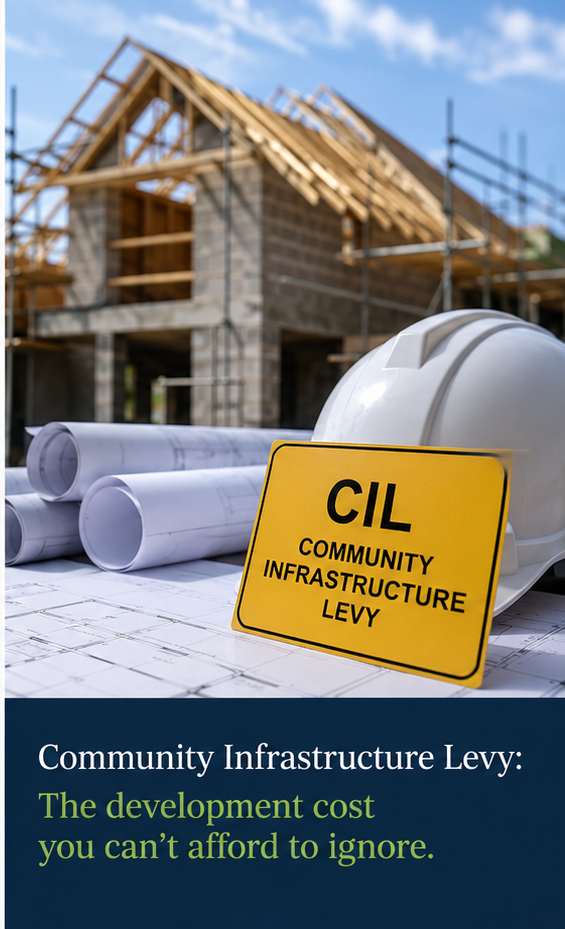
Buying land, converting a building or constructing a new home involves a long list of expected costs.
There is the purchase price, professional fees, planning costs, materials, labour, finance and tax.
One cost that is sometimes overlooked is the Community Infrastructure Levy, usually shortened to CIL.
Failing to deal with CIL correctly can turn an apparently profitable development into a much more expensive project.
What is the Community Infrastructure Levy?
CIL is a charge that local authorities can impose on certain new developments.
The money raised is intended to support infrastructure needed as an area develops. This might include roads, schools, transport facilities, health services and other local infrastructure.
CIL does not apply uniformly across every local authority area. A local authority must adopt and publish a charging schedule setting out:
- whether the levy applies;
- which developments are chargeable;
- the rates applying to different uses; and
- any geographical variations.
The starting point for any development is therefore to check the position with the relevant local authority.
What developments can be caught?
A development may potentially fall within CIL where it:
- creates 100 square metres or more of additional internal floor space; or
- creates a new dwelling.
A new dwelling can potentially be caught even where the additional floor area is below 100 square metres.
CIL can therefore be relevant to more than large commercial developments. It may affect:
- self-build homes;
- property conversions;
- the construction of additional dwellings;
- residential annexes;
- extensions;
- commercial developments; and
- projects involving a change of use combined with building work.
Whether a particular development is chargeable depends on the local charging schedule, the existing use of the building and the precise nature of the works.
How is the charge calculated?
Where CIL applies, the charge is generally based on:
- The amount of chargeable additional floor space.
- The rate applying to that category of development.
- Indexation adjustments.
- Any relief or exemption successfully claimed.
The rate may differ according to the development type and its location within the local authority area.
A residential development in one part of an authority may face a different rate from commercial premises or a development in another charging zone.
That means a rough estimate based solely on the size of the project can be misleading.
Available exemptions and reliefs
A number of exemptions and reliefs may be available, including those relating to:
- minor developments;
- residential extensions;
- residential annexes;
- self-build homes;
- charitable developments;
- social housing; and
- exceptional circumstances.
However, the existence of an exemption does not mean it applies automatically.
Applications, supporting documentation and procedural requirements may need to be completed at the correct stage.
In some cases, starting work before all the necessary forms have been submitted can result in the relief being lost.
The self-build trap
The self-build exemption can be extremely valuable, but it comes with conditions.
The applicant may need to submit the prescribed forms, receive confirmation and provide further evidence after completion.
The property may also need to be occupied as the applicant’s principal residence for a specified period. A sale or letting during that period can potentially trigger a clawback of the relief.
Anyone relying on the self-build exemption should understand both the initial application process and their continuing obligations after the building is completed.
Do not start work too early
The point at which development is treated as commencing can be critically important.
Commencement may include more than beginning the main construction work. Certain preparatory operations could potentially count, depending on the circumstances.
Starting before the correct notices have been submitted can result in:
- loss of an exemption;
- surcharges;
- interest;
- accelerated payment requirements; and
- a significant unexpected liability.
Developers should therefore confirm the CIL position before contractors begin work on site.
Information required during the planning process
Applicants seeking planning permission are generally expected to provide information about the proposed development, including details relevant to the calculation of CIL.
The source material identifies the Additional CIL Information form, commonly referred to as Form 1, as part of this process.
Other forms or notices may then be required depending on whether:
- the development is chargeable;
- ownership changes;
- an exemption is being claimed;
- responsibility for the levy is being assumed; or
- work is about to commence.
CIL should not be treated as something to resolve after planning permission has been granted.
Include CIL in the appraisal from day one
Before purchasing a development site or committing to a project, your financial appraisal should consider:
- whether the local authority charges CIL;
- the applicable rate;
- the expected chargeable floor area;
- whether existing floor space can be deducted;
- whether an exemption is available;
- the conditions attached to that exemption;
- the payment timetable; and
- the risk of surcharges or loss of relief.
A development that appears viable before CIL may look very different once the levy, professional fees and financing costs are included.
Ignorance is not a defence
CIL is particularly dangerous because developers may not realise that a liability exists until after key deadlines have passed.
By then, the opportunity to claim relief may have been lost.
The safest approach is to involve your planning adviser, solicitor and accountant at the earliest stage, and to obtain confirmation from the local authority before commencing development.
Planning a development?
At williams lester accountants, we help property owners and developers understand the wider financial and tax consequences of a project.
We can incorporate the expected levy, tax charges, finance costs and projected returns into your development appraisal—helping you decide whether the project genuinely stacks up before you commit.