Incomplete VAT Invoice? What To Do Before You Reclaim VAT
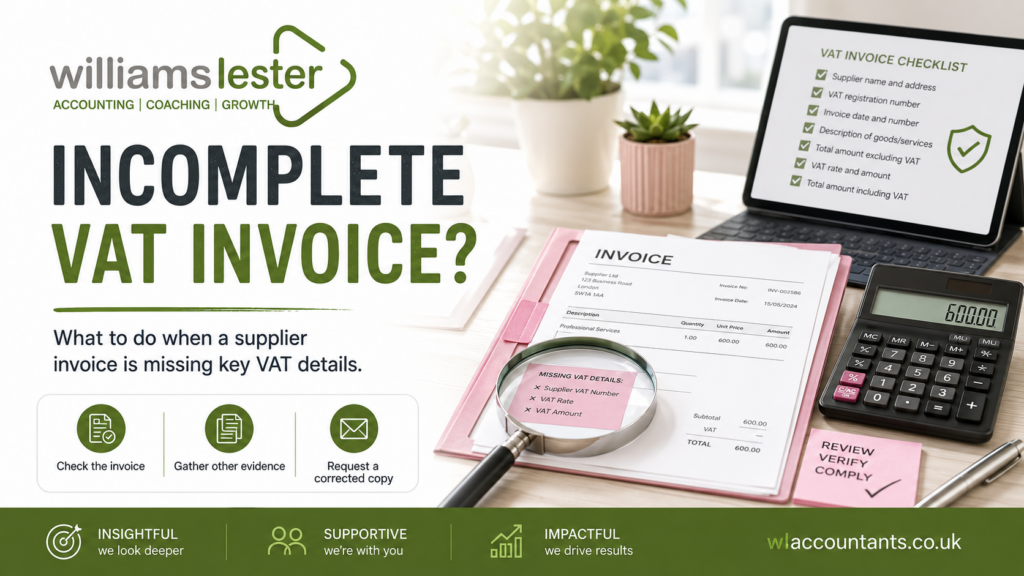
A full VAT invoice normally needs to include key information such as:
- the supplier’s name, address and VAT registration number
- a unique invoice number
- the invoice date
- the customer’s name and address
- a description of the goods or services supplied
- the VAT rate charged
- the net amount
- the VAT amount
- the total gross amount payable
If important information is missing, HMRC may challenge the VAT recovery.
Common problems include invoices that do not show the VAT registration number, do not show VAT separately, lack detail about what was supplied, or are made out to the wrong person or business.
Why the name on the invoice matters
The invoice should usually be addressed to the VAT-registered business making the claim.
Problems can arise where an invoice is issued in the name of a director, employee or another individual instead of the company.
That does not automatically mean the VAT claim is impossible, but it does make the position harder to support.
Is VAT recovery automatically lost?
Not necessarily.
A recent First-tier Tribunal case, Athena Luxe Ltd v HMRC [2025], looked at this issue.
HMRC had disallowed VAT recovery because some invoices were incomplete, and some were issued in employees’ names rather than the company’s name.
The Tribunal found in favour of the taxpayer. It accepted that the business had genuinely bought the goods, paid for them through the company, and had done what it could to obtain corrected invoices.
The case confirmed that HMRC should consider all the available evidence, not simply reject a claim because the invoice is imperfect.
That said, this was a First-tier Tribunal decision, so it is persuasive rather than binding on all future cases.
Do not rely on HMRC discretion if you can avoid it
The safest approach is always to obtain a correct VAT invoice from the supplier.
If an invoice is wrong or incomplete, ask for a corrected version as soon as possible.
If that is not possible, keep as much supporting evidence as you can, such as:
- bank statements
- receipts
- purchase orders
- contracts
- delivery notes
- emails with the supplier
- expense claim records
- proof that the goods or services were used by the business
The goal is to show that a genuine business purchase took place and that VAT was properly incurred.
E-invoicing may reduce invoice errors
E-invoicing is likely to reduce some of these problems over time.
Under a typical e-invoicing system, invoice data is created in a structured digital format rather than as a paper invoice or PDF. This should make invoice details easier to process and less prone to basic mistakes.
From April 2029, UK VAT-registered businesses will be required to create, send, receive and process invoices to other businesses in a compliant electronic format.
As systems improve, HMRC may become less tolerant of basic invoice errors because they should be easier to avoid.
The key point
An incomplete VAT invoice does not always mean VAT recovery is lost.
But it does mean you need to tread carefully.
Correct the invoice where possible. Keep supporting evidence. Make sure the purchase was genuinely for the business. And do not assume HMRC will accept a claim just because the VAT was paid.
At williams lester accountants, we help businesses keep their VAT records clean, compliant and ready for HMRC scrutiny.