
VAT Deregistration: When Can You Cancel Your VAT Registration or Change Schemes?
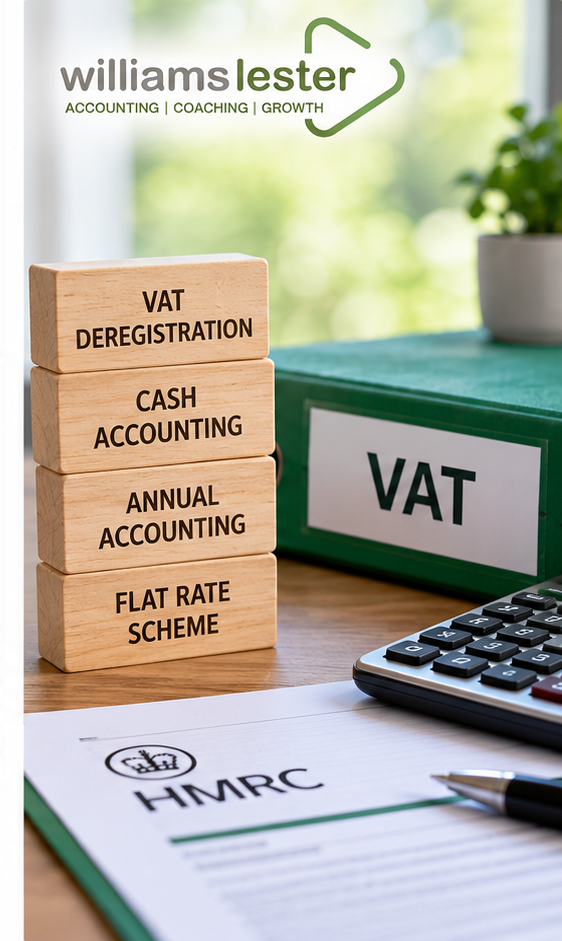
Is your business paying more VAT than it needs to? Whether your turnover has fallen, your business is changing or your current VAT scheme no longer suits you, understanding your options could save money and improve cash flow.
VAT registration is an important milestone for many growing businesses.
But what happens when your circumstances change?
Perhaps your turnover has fallen below the VAT threshold. Maybe you’re scaling back as retirement approaches. Or perhaps the VAT scheme you originally chose is no longer the most suitable for your business.
In some circumstances, you may be able to cancel your VAT registration entirely. In others, simply changing the way you account for VAT could be the better solution.
The important thing is understanding the difference.
When can a business deregister for VAT?
As at October 2026, the UK VAT registration threshold is £90,000.
However, the threshold for cancelling an existing VAT registration is slightly lower, at £88,000.
A VAT-registered business can generally apply to deregister voluntarily if it can demonstrate that its taxable turnover is expected to fall below £88,000 over the following 12 months.
For example, a business previously generating £110,000 in annual taxable sales might have reduced its activities and now expects turnover of just £70,000.
Provided the relevant conditions are satisfied, it may be eligible to cancel its VAT registration.
It is important to remember that the deregistration threshold is based on expected future taxable turnover, rather than simply what happened in the previous financial year.
Businesses that cease making taxable supplies or otherwise cease to qualify for VAT registration may be required to deregister.
Is VAT deregistration always a good idea?
Not necessarily.
For some businesses, cancelling VAT registration can improve competitiveness and reduce administration.
For others, remaining registered may be financially advantageous.
Consider two different businesses.
Business A: A hairdresser serving private customers
A hairdresser with annual taxable turnover of £65,000 primarily serves customers who cannot reclaim VAT.
If the business deregisters, it may be able to reduce its prices or improve its profit margins.
However, it will lose the ability to reclaim VAT on most future purchases.
Business B: A consultancy working with VAT-registered companies
A consultancy also generates £65,000 in annual taxable turnover, but almost all its clients are VAT-registered businesses that can reclaim VAT.
Remaining VAT-registered may make commercial sense, particularly if the consultancy incurs significant VAT on software, equipment or subcontracted services.
The important consideration is not simply whether you can deregister, but whether doing so benefits your business.
What happens when you cancel VAT registration?
One of the biggest surprises for business owners is that deregistration can create a final VAT liability.
When a business cancels its registration, it may need to account for VAT on certain stock and business assets it still owns.
This generally applies where VAT was reclaimed, or could have been reclaimed, when those assets were acquired.
HMRC allows an exception where the total VAT due on the relevant assets would be £1,000 or less.
If the amount exceeds £1,000, VAT may be payable on the relevant assets.
Example: Deregistering with equipment and stock
Imagine a small business has reduced its trading activities and qualifies for VAT deregistration.
On the cancellation date, it still owns:
- Business equipment worth £4,000
- Trading stock worth £3,000
- Office furniture worth £1,000
Assume these are current market values excluding VAT and all the items are subject to VAT at 20%, with the necessary input tax conditions satisfied.
The total value is £8,000.
Potential VAT due on deregistration:
£8,000 × 20% = £1,600
Because the VAT exceeds the £1,000 limit, the business may need to account for £1,600 on its final VAT return.
Without proper planning, this could create an unexpected tax bill at precisely the time the business is reducing its activities.
How do you cancel your VAT registration?
In most straightforward cases, cancellation can be requested through your HMRC business tax account.
Alternatively, you can use form VAT7.
Where cancellation is compulsory, HMRC must generally be notified within 30 days of the relevant change.
Businesses should continue to charge and account for VAT as required until HMRC confirms the effective cancellation date.
After deregistration, a final VAT return will usually be necessary.
You may also be able to reclaim qualifying VAT on invoices received after deregistration, where the expenditure relates to the period during which the business was registered.
What if you want to stay VAT-registered but change schemes?
Deregistration is only one option.
Businesses can also choose between several methods of accounting for VAT, depending on their turnover, activities and eligibility.
The main schemes include the Standard VAT Accounting Scheme, Cash Accounting Scheme, Annual Accounting Scheme and Flat Rate Scheme.
VAT Cash Accounting Scheme
Under standard VAT accounting, businesses generally account for VAT based on invoice dates, even if customers have not yet paid.
Cash accounting works differently.
You generally account for output VAT when customers pay you, rather than when you issue invoices.
Similarly, you normally reclaim input VAT when you pay suppliers.
This can offer a valuable cash-flow advantage where customers take a long time to settle invoices.
Businesses with expected annual taxable turnover of £1.35 million or less can generally join the scheme, subject to eligibility conditions.
They must ordinarily leave when taxable turnover exceeds £1.6 million.
If a business leaves the scheme, outstanding VAT on unpaid invoices must be dealt with under the transition rules. In some circumstances, a six-month accounting adjustment period is available.
Our view: Cash accounting can be particularly attractive to businesses experiencing slow-paying customers, although the overall financial benefit depends on their circumstances.
VAT Annual Accounting Scheme
The Annual Accounting Scheme allows eligible businesses to submit one VAT return each year instead of the usual four quarterly returns.
Businesses make instalment payments throughout the year, followed by a balancing payment or refund.
The scheme can simplify VAT administration and make payment schedules more predictable.
The main thresholds are:
- Joining threshold: £1.35 million taxable turnover
- Leaving threshold: £1.6 million taxable turnover
However, annual accounting is not suitable for everyone.
For example, businesses regularly receiving VAT refunds may prefer more frequent returns to avoid waiting longer to recover money.
Businesses wishing to leave the scheme must notify HMRC and follow the appropriate exit procedure.
VAT Flat Rate Scheme
The Flat Rate Scheme is designed to simplify VAT accounting for eligible smaller businesses.
Instead of calculating VAT payable using the normal difference between output VAT and recoverable input VAT, businesses generally pay a fixed percentage of their VAT-inclusive turnover.
The percentage depends on the type of business, and special rules apply to limited-cost traders.
Businesses with expected taxable turnover of £150,000 or less, excluding VAT, can generally apply to join.
Businesses must normally leave when they exceed the relevant £230,000 turnover limit or meet other conditions requiring them to exit.
The scheme can be convenient, but it is not always tax-efficient.
For businesses with substantial VAT-bearing expenses, standard VAT accounting may produce a better result.
Regularly reviewing the scheme is therefore important.
Can you switch VAT schemes without deregistering?
Yes.
Leaving a VAT accounting scheme does not automatically mean cancelling your VAT registration.
For example, a business moving from the Flat Rate Scheme to standard VAT accounting will normally retain its VAT registration number.
However, each scheme has different rules about when you can leave, whether HMRC must be notified and how outstanding VAT is accounted for.
Getting these transitions wrong can lead to incorrect VAT returns and cash-flow difficulties.
Five things to check before making a decision
Before cancelling your registration or changing VAT schemes, consider the following:
1. Forecast your turnover
Are you genuinely expecting a sustained reduction in sales, or is the downturn temporary?
2. Review your customer base
Do most of your customers reclaim VAT, or are they private consumers who bear the VAT cost?
3. Examine your expenses
How much VAT do you currently reclaim on purchases, equipment and overheads?
4. Check your existing assets
Would deregistration trigger a VAT liability on stock, equipment or property?
5. Consider future growth
If your turnover increases again, will you need to re-register and potentially change your prices?
These questions should form part of a wider financial review rather than being treated as a simple compliance exercise.
How williams lester accountants can help
At williams lester accountants, we believe VAT planning should be about more than submitting returns on time.
The VAT scheme you choose can affect your pricing, profitability, cash flow and administrative workload.
We can help you:
- Review whether your current VAT scheme remains appropriate.
- Assess whether voluntary deregistration could benefit your business.
- Calculate potential VAT liabilities on remaining stock and assets.
- Manage a transition between VAT accounting schemes.
- Prepare and submit the necessary VAT returns and notifications.
- Improve bookkeeping and VAT reporting using Xero, QuickBooks or FreeAgent.
Our approach combines practical accountancy support with commercial advice to help you make better financial decisions.
Not sure whether your business should remain VAT-registered?
Speak to williams lester accountants for a review of your VAT position.
Sometimes a relatively small change to the way your business handles VAT can make a meaningful difference to cash flow and profitability.
VAT thresholds and scheme rules quoted are those applicable in October 2026. Eligibility, exceptions and transitional arrangements can affect the position of individual businesses.