Are You Missing Out on £300 of Tax-Free Perks?
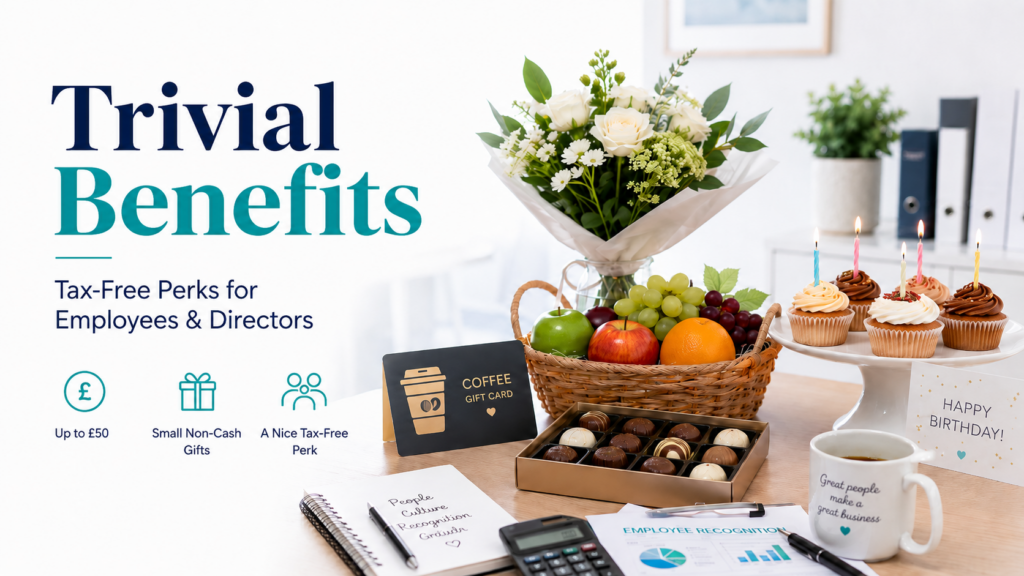
Trivial benefits are one of those tax rules that sound almost too good to be true.
Your limited company can buy you or your employees small gifts, the recipient pays no tax on them, and the company can normally claim tax relief on the cost.
What is not to like?
The problem is that plenty of directors either never use the exemption at all or follow some questionable advice they have seen online and push it far too far.
As usual, the sensible answer is somewhere in the middle.
What counts as a trivial benefit?
A trivial benefit is basically a small, non-cash gift from the company.
That could be:
- a bottle of wine
- chocolates
- flowers
- a birthday present
- a Christmas gift
- a coffee gift card
- cakes for the office
- an occasional takeaway lunch
It does not need to be covered in your company logo or have an obvious business purpose.
Your company is allowed to give people something nice occasionally.
But HMRC has four rules, and you need to meet all of them.
Rule one: keep it at £50 or less
Each individual benefit must cost no more than £50, including VAT.
And £50 really does mean £50.
Spend £50.01 and you do not just pay tax on the extra penny. The entire benefit falls outside the exemption.
So check the receipt rather than guessing.
Rule two: no cash
You cannot put £50 in an envelope and call it a trivial benefit.
Cash vouchers are also excluded.
Normal non-cash gift cards can potentially qualify because they can only be used to buy goods or services. But they must still meet all the other rules.
Rule three: do not make it contractual
The benefit must not be something the employee is entitled to receive.
If it is written into their contract, included in a salary sacrifice arrangement or promised as part of their normal package, it is not trivial.
A birthday or Christmas gift given every year will not automatically become contractual. But providing the same thing constantly could start to look more like an entitlement than an occasional gesture.
In other words, a surprise cake is fine. A legally enforceable Friday cake allowance is probably taking things too far.
Rule four: it cannot be a performance reward
This is the one that catches people out.
You cannot give somebody a £50 voucher for hitting a sales target and call it tax free.
That is a reward for doing their job, which makes it taxable in the same way as a bonus.
The gift needs to be independent of performance.
“Happy birthday” may qualify.
“Congratulations on smashing your target” probably will not.
What can directors claim?
Directors of close companies have an annual trivial benefits limit of £300 per tax year.
Most small, owner-managed limited companies are close companies, so this is likely to apply to you.
People often turn this into “six lots of £50”, which is fine as a simple way to understand it, but the actual rule is:
- no individual benefit can exceed £50
- the total qualifying benefits cannot exceed £300
- the limit follows the tax year, not your company year
You could therefore have six gifts of £50, ten gifts of £30 or another combination.
Each gift still needs to be genuinely separate and meet the rules.
Please be careful with the £300 Amazon voucher trick
You may have seen advice suggesting that the company should buy £300 of Amazon vouchers at the beginning of the tax year and gradually use them throughout the year.
I would be very cautious with this.
HMRC could argue that the company provided one £300 benefit when the vouchers were bought or handed over.
If that happens, the benefit is over £50 and the whole exemption could fail.
The boring approach is often the safest: provide separate, genuine and occasional gifts during the year and keep the receipts.
Boring tax planning is usually better than exciting correspondence with HMRC.
What about a monthly gym membership?
This is another common question.
A director sees a gym subscription costing £25 a month and thinks:
“It is under £50, so surely it qualifies?”
Unfortunately, probably not.
You are not really buying a series of unrelated £25 gifts. You are entering into an ongoing subscription arrangement that may cost £300 over the year.
It is regular, linked and contractual, which makes it very difficult to treat as a trivial benefit.
Record everything properly
Your bookkeeping should show:
- what was purchased
- when it was provided
- who received it
- how much it cost, including VAT
- why it was given
- the running annual total for each director
This matters because not everything should automatically be posted to “trivial benefits”.
A meal might actually be travel subsistence, client entertaining, staff entertaining or part of the annual staff party exemption.
Using the correct category could preserve the director’s £300 allowance for genuine trivial benefits.
Should you use trivial benefits?
Yes — sensibly.
They are a legitimate and useful exemption, particularly for owner-managed companies.
Just remember that they are supposed to be trivial.
Keep them occasional, keep each benefit within £50, avoid anything contractual or performance-related and keep proper records.
That way, your company can give you and your team a few tax-free perks without creating a future headache.
At williams lester accountants, we help limited company owners understand what the business can legitimately pay for and how to take money from the company tax efficiently.
Get in touch if you would like us to review your current approach.