
Received a P800 Letter from HMRC? You Could Be Owed a Tax Refund
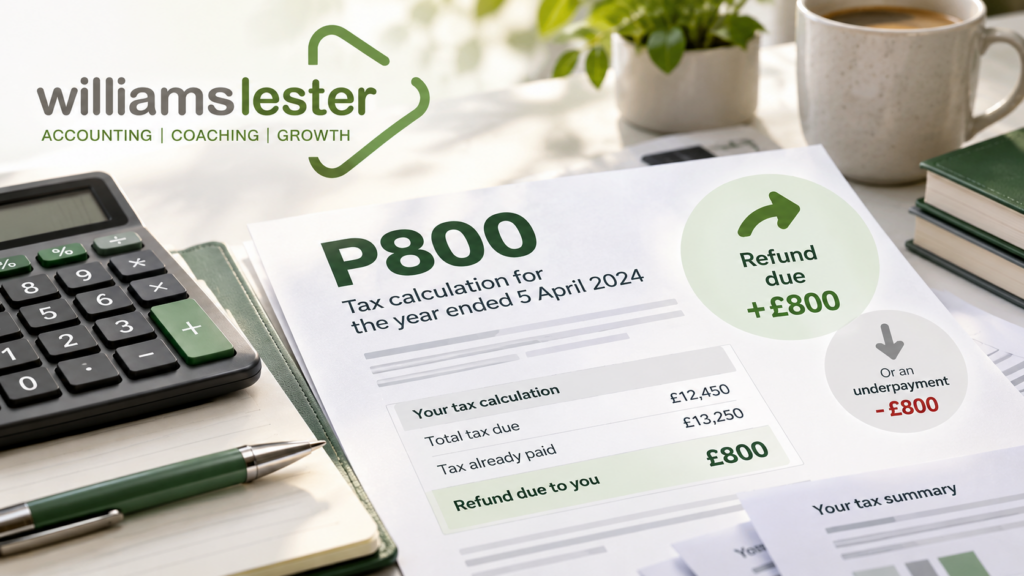
Received an unexpected letter from HMRC telling you that you’ve paid too much or too little tax? Before you ignore it, pay it or claim the refund, it’s worth checking whether HMRC’s calculations are actually correct.
Every year, HMRC reviews the Income Tax paid by millions of employees and pensioners.
For some taxpayers, the amount deducted through PAYE doesn’t match their actual tax liability.
Where this happens, HMRC may issue a P800 tax calculation showing whether tax has been overpaid or underpaid.
For some people, the letter brings welcome news of a refund.
For others, it can mean an unexpected tax bill.
Either way, understanding the figures is important.
What is a P800 tax calculation?
A P800 is an end-of-year Income Tax calculation produced by HMRC.
It compares the tax you should have paid with the amount actually deducted from your income.
P800 calculations are commonly issued to individuals who receive income through employment or pensions and do not normally complete a Self Assessment tax return.
If you complete a Self Assessment return, your tax liability will generally be dealt with through that system instead.
The P800 calculation may show:
- Your total taxable income.
- The Personal Allowance and other relevant tax allowances.
- The Income Tax HMRC believes was due.
- The tax already deducted.
- Any resulting underpayment or overpayment.
Why might HMRC think you’ve paid the wrong amount?
There are several common reasons.
Changing jobs during the tax year
If you move between employers, your new employer may initially use an emergency tax code or calculate deductions without complete details of your previous earnings.
Having more than one job
Where you have two employments, the allocation of your Personal Allowance and tax codes can affect how much tax is collected.
Receiving employment income and a pension
If you start drawing a pension while continuing to work, HMRC must consider both sources of income.
Incorrect tax codes
A tax code that doesn’t reflect your circumstances can result in too much or too little tax being deducted.
Taxable state benefits
Certain benefits, including Jobseeker’s Allowance and some Employment and Support Allowance payments, can affect the overall tax calculation.
Changes in personal circumstances
Changes to allowances, employment benefits or other taxable income can also create adjustments.
What happens if HMRC owes you money?
If your P800 shows that you have overpaid Income Tax, the letter will explain how to claim your refund.
In many cases, you can request a repayment through the GOV.UK website, your HMRC Personal Tax Account or the HMRC app.
Where the online service is available, you will generally need your P800 reference number and National Insurance number.
HMRC indicates that online repayment claims are normally paid within five working days.
Alternatively, you may be able to request a cheque.
If your P800 states that HMRC will automatically send you a cheque, you generally don’t need to submit a separate claim.
Example: A £650 tax refund
Imagine you changed jobs during the 2025/26 tax year.
Your new employer initially operated an emergency tax code, resulting in additional tax deductions.
After the tax year ended, HMRC reviewed your employment records.
The calculation shows:
| Description | Amount |
| Actual Income Tax liability | £5,200 |
| Income Tax deducted through PAYE | £5,850 |
| Tax overpaid | £650 |
HMRC should arrange repayment of the £650 overpayment using the process explained in your P800.
However, it remains important to check the underlying employment figures.
If HMRC has missed an income source or used incorrect information, the refund calculation could be wrong.
What if HMRC says you owe tax?
A P800 can also identify an underpayment.
For example, suppose you received employment income and a pension during the same tax year.
If both sources operated tax codes that allowed too much tax-free income, you may have underpaid Income Tax.
HMRC may recover smaller underpayments by adjusting your PAYE tax code.
Generally, where the underpayment is less than £3,000 and the relevant conditions are met, HMRC can collect it through PAYE rather than demanding an immediate lump sum.
If this is not possible, HMRC will explain how the outstanding tax should be paid.
Example: A £900 underpayment
Suppose HMRC calculates that you should have paid £7,400 in Income Tax during the year.
However, only £6,500 was deducted.
This leaves an underpayment of £900.
If HMRC collects this through your tax code over 12 months, the additional deductions would be equivalent to approximately £75 per month.
This is an illustrative calculation. The actual timing and deductions depend on how HMRC adjusts the tax code.
Can HMRC get a P800 wrong?
Yes.
Although HMRC receives information from employers, pension providers and other sources, errors can occur.
Problems can arise where:
- Employment income is duplicated or missing.
- Pension income has been recorded incorrectly.
- The wrong tax allowances have been applied.
- HMRC has used outdated information.
- More than one income source is involved.
- Savings income or applicable tax bands have been calculated incorrectly.
The interaction between employment income, pension income and savings income can be particularly complicated.
For example, certain taxpayers may qualify for the starting rate for savings or the Personal Savings Allowance.
Incorrectly allocating tax allowances can result in an inaccurate liability.
Should you pay immediately if HMRC says you owe money?
Before making payment, check that the calculation agrees with your records.
Compare the figures with your P60, P45, payslips, pension statements and any relevant benefits information.
If something doesn’t look right, contact HMRC and explain the discrepancy.
Where HMRC accepts that its calculation is incorrect, it can issue a revised P800.
If you disagree with the explanation, professional advice may help establish whether there are grounds for further challenge.
Beware of fake HMRC refund messages
Tax refunds are a common subject of fraudulent emails and text messages.
Scammers may send messages claiming that a refund is waiting and directing you to a website requesting banking information.
Always access HMRC services through GOV.UK or the official HMRC app.
Do not assume a tax refund message is genuine simply because it displays HMRC’s name or branding.
How williams lester accountants can help
At williams lester accountants, we help individuals understand their tax position and resolve discrepancies with HMRC.
Whether your P800 shows a refund or an unexpected amount to pay, we can review the calculation, identify potential errors and advise on the next steps.
We can also help where employment income, pensions, benefits or other income sources make your tax affairs more complicated.
Received a P800 letter you’re not sure about?
Don’t assume HMRC has necessarily got everything right.
Let us help you understand the figures and ensure you’re paying the correct amount of tax.
This article provides general guidance on P800 tax calculations and PAYE reconciliation procedures applicable in October 2026.